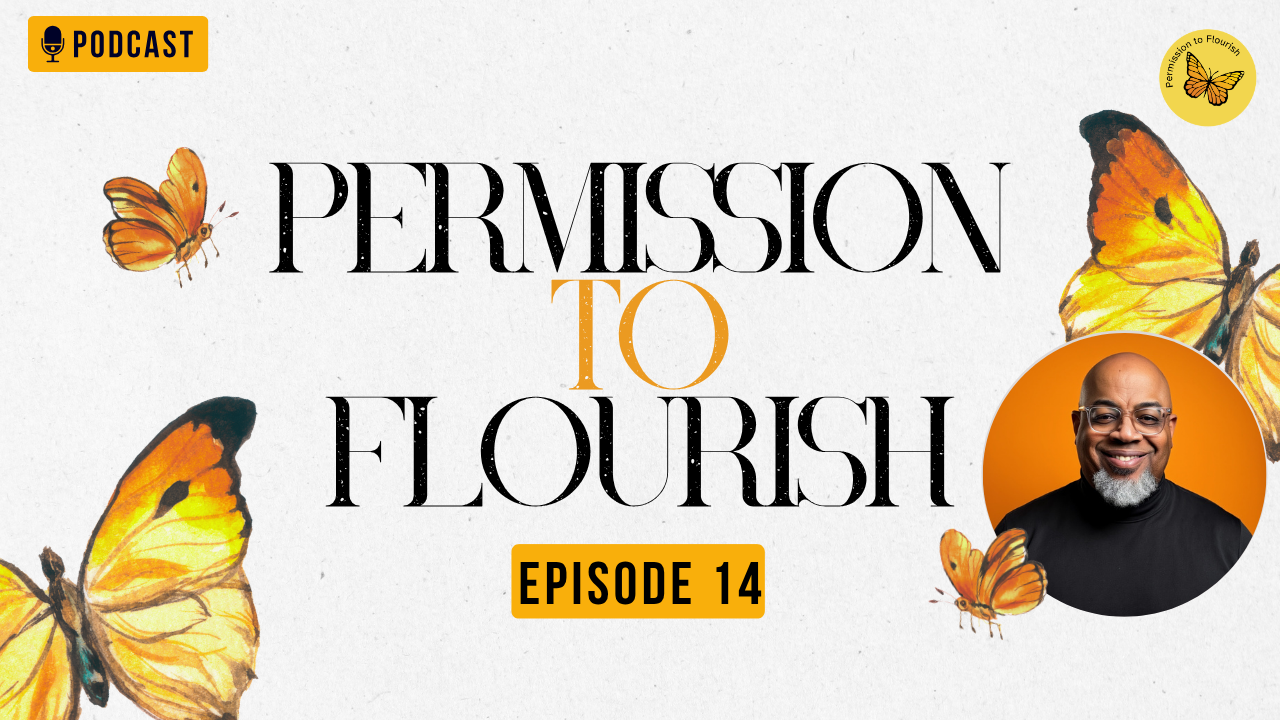
How to Navigate Menopause in Marriage: A Guide for Husbands with Russell Betts
Midlife changes can quietly fracture even the strongest and most loving of marriages. Often, the success we achieve in our careers and leadership roles ends up outpacing our emotional capacity at home. When the physical and emotional shifts of menopause are added to the mix, many couples find themselves drifting apart, overwhelmed by a season they don’t fully understand.
But what if the tension of midlife wasn’t a crisis, but rather a profound invitation for a relational upgrade?
In Episode 14 of the Permission to Flourish podcast, host J. Cornell sits down with Russell Betts, relationship expert, founder of Connected Through Change™, and author of the Amazon bestseller The Good Husband’s Guide to Menopause. Drawing from his own 30-plus years of marriage, Russell shares invaluable insights on how high-achieving couples can stay connected during seasons of stress and transition.
If you or your partner are navigating midlife and want to future-proof your relationship, this episode is a must-listen. Here are the core takeaways from their powerful conversation.
The “Relational Capacity Gap” in Midlife
Why do so many strong marriages feel destabilized during midlife? Russell explains that it often comes down to what he calls the Relational Capacity Gap.
For many high-achievers, the skills that make them successful in their careers—relentless drive, problem-solving, and logic—do not translate well to emotional intimacy at home. Over time, a gap forms between their professional success and their relational capacity. When the stress of a major life transition like menopause hits, that gap is exposed. The resulting conflicts are rarely character issues; rather, they are capacity issues. Couples simply lack the structural tools and shared language to hold the weight of the transition.
Menopause is a Relational Transition, Not Just a Hormonal One
One of the most misunderstood aspects of menopause is treating it purely as a medical event. Russell emphasizes that a hormonal transition is a relational transition.
Menopause acts as a massive disruption to a woman’s nervous system. With over 37 different recognized symptoms—and a shocking statistic revealing that only 20% of OBGYNs receive formal menopause training—women often experience severe emotional and physical isolation.
What men frequently misinterpret as anger, distance, or a sudden change in personality is actually their partner’s nervous system going into overdrive. Because this internal chaos is largely invisible, husbands often misread the situation, leading to defensiveness and a breakdown in communication exactly when their wives need them the most.
The “Fix-It” Reflex: What Husbands Often Get Wrong
When a husband sees his wife in distress, his natural, well-intentioned instinct is to step in and fix the problem. However, during menopause, this “fix-it” mode is the exact opposite of what is needed.
Russell offers crucial, actionable advice for men who feel like they are constantly “walking on eggshells”:
Step out of strategy and into presence: Your wife does not need you to solve her menopause; she needs you to safely witness it.
Do not take the reactions personally: Understand that the emotional fluctuations are physiological. Taking things personally turns her health transition into a conflict about you.
Create a haven of emotional safety: Shift from offering unsolicited advice to actively listening and validating her experience.
Turning a “Midlife Crisis” into a Relational Upgrade
We have all heard the trope of the midlife crisis, but Russell challenges us to reframe it. Instead of a crisis, midlife is an invitation.
Couples who fracture during this season do so because they try to force the relationship back to what it was in their 20s or 30s. Couples who deepen their bond recognize that they must build Relational Intelligence (RQ) to meet the new version of their partner. By learning to regulate their nervous systems and communicating with grace, couples can use the friction of midlife to establish a healthier, more mature baseline for their marriage.
Giving Yourself Permission to Flourish
When asked what it means to give oneself Permission to Flourish, Russell’s answer is beautifully straightforward: It is giving yourself the grace to accept life’s inevitable shifts and actively pursuing the next best version of yourself, rather than clinging to who you used to be.
Ready to Upgrade Your Relationship?
If you want to stop the midlife drift and learn how to build a marriage strong enough to hold success without collapsing under it, dive into the full conversation on Episode 14 of the Permission to Flourish podcast!
Listen to the full episode on your favorite podcast platform.
Connect with Russell Betts & Access Practical Tools: